
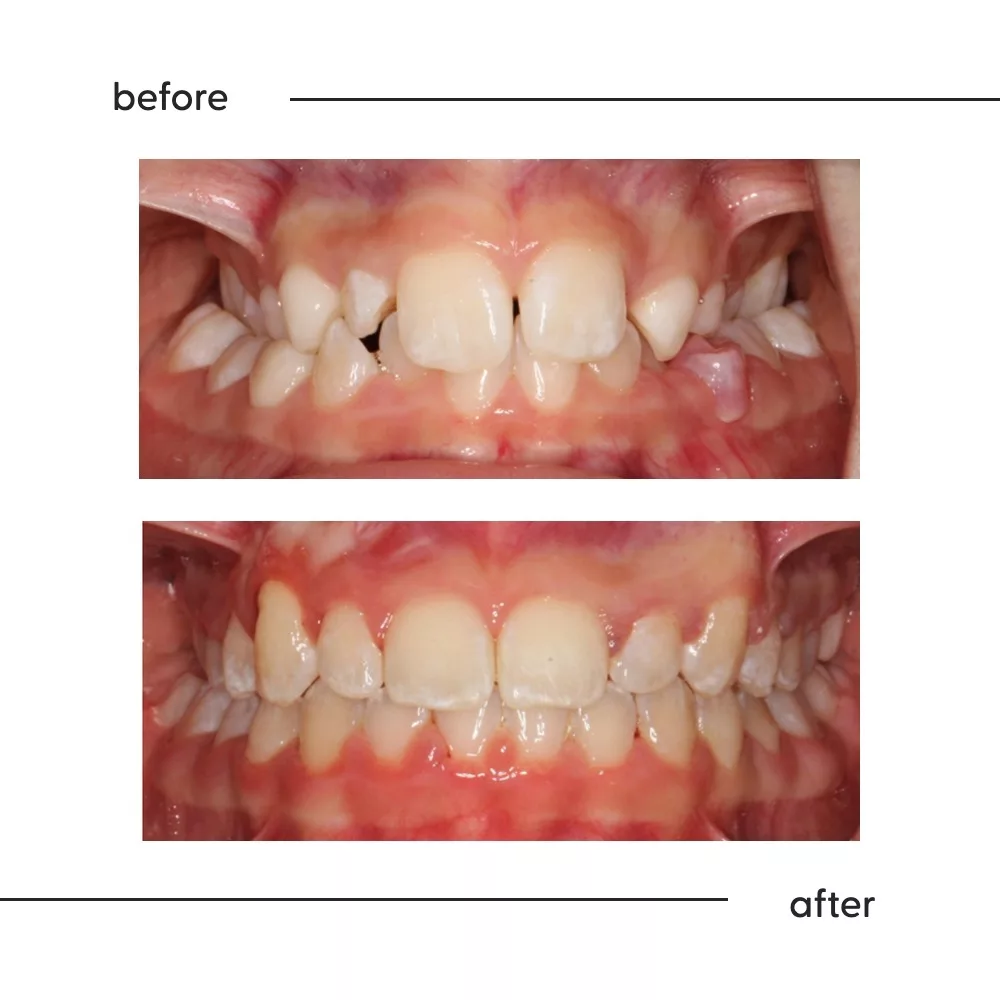
Gently widening a narrow upper jawwhile your child is still growing
A palatal expander is a small, well-tolerated appliance that guides a narrow upper jaw wider, creating room for teeth and correcting a crossbite before it becomes harder to treat.
Specialist care from Dr Shaz MacAvoy at Newmarket and Albany. Your first visit is a complimentary Smile Assessment with our Treatment Coordinator. Early treatment from $4,500.
A gentle way to widen the upper jaw
Small, gradual changes at the right age can make a lasting difference.
A palatal expander is a small appliance that gently and gradually widens a narrow upper jaw, known as the maxilla. In growing children the upper jaw is still in two halves joined by a central growth line called the mid-palatal suture. While that line is still open, an expander can guide the jaw wider in a controlled, comfortable way.
Because it works with your child's natural growth, an expander is often an early, interceptive step. Creating the right amount of width early can simplify the treatment that follows and, in many cases, reduce how much is needed later. It is a routine part of children's orthodontics and one Dr Shaz will only recommend when there is a clear reason for it.
Common reasons an expander helps
Correcting a crossbite
When the upper back teeth sit inside the lower ones (a posterior crossbite), widening the upper arch brings the bite into a healthier position.
Making room for teeth
Extra width can relieve crowding, help blocked-in teeth and create space so an impacted tooth has a path to come through.
Supporting easier breathing
In some children a wider, less narrow arch can support better nasal breathing. Dr Shaz will explain whether this applies to your child.
The right option for your child
There is no single design that suits everyone, so the choice is made after a careful assessment.
Fixed rapid palatal expander (RPE)
A fixed rapid palatal expander is bonded to the upper back teeth and stays gently in place. It is activated at home with a small key that you turn on the schedule Dr Shaz provides, so the widening happens in tiny, controlled steps.
Removable expanders
For milder cases, a removable expander may be suitable. Dr Shaz recommends the right appliance after reviewing your child's growth, bite and the amount of width needed.
When an expander works best
Expanders work best while a child is still growing, because the mid-palatal suture is still open and responsive. The pre-teen and early-teen years are the usual window, which is exactly why an early check matters so much.
An assessment around this stage helps us see whether treatment is needed now, later or not at all. You can read more about the right age to start to understand when a first visit is most useful, even if nothing needs doing yet.
From fitting to a settled new width
Fitting is comfortable and the expander is cemented gently into place, so there is nothing for your child to take in and out. At home, you turn the key on the exact schedule given. A feeling of pressure or tightness for a few minutes after each turn is normal and soon eases.
A small gap can open between the upper front teeth as treatment progresses. This is a good sign that the jaw is widening, and the gap usually closes on its own in the weeks that follow. Speech and eating can feel a little odd for a day or two, then quickly settle as your child adapts.
Once the right width is reached, a holding period keeps everything stable while new bone fills in along the suture. From there, braces or further treatment often follow to fine-tune the bite and align the teeth. Children adapt to expanders quickly, and it remains a routine, well-tolerated appliance.
Common questions about palatal expanders
Does a palatal expander hurt?
No. Fitting is comfortable and the appliance is cemented gently in place. After each turn of the key your child may feel pressure or tightness for a few minutes, which then settles. Most children adapt very quickly.
Why has a gap appeared between the front teeth?
A small gap opening between the upper front teeth is a good sign that the jaw is widening as intended. It usually closes on its own over the following weeks, and any remaining adjustment is handled later in treatment.
How long is an expander worn?
The active widening phase is often short, followed by a holding period so the new width stays stable while fresh bone fills in. The exact timing depends on your child, and Dr Shaz will explain the plan at your assessment.
Will my child still need braces afterwards?
Often, yes. An expander creates room and corrects width, and braces or further treatment frequently follow to align the teeth and refine the bite. Sometimes early expansion makes that later stage simpler.
What age is best for an expander?
Expanders work best while a child is still growing and the mid-palatal suture is open, usually the pre-teen and early-teen years. An early check helps us find the ideal window for your child.
How much does a palate expander cost in NZ?
At Milk Orthodontics an expander is part of early (Phase 1) treatment, which starts from $4,500 all-inclusive of the appliance, fitting, every adjustment visit and the holding period. If we can see that braces will follow later, both phases are quoted together, usually $11,900 to $12,500, with an interest-free plan over around 30 months. The first Smile Assessment is free.
How do I care for the appliance at home?
Keep it clean with gentle brushing, follow the turning schedule exactly and avoid very hard or sticky foods. We will show you everything at the fitting and are always here between visits if you have questions.
See whether an expander could help your child
A complimentary Smile Assessment with our Treatment Coordinator is the first step. If an expander looks worthwhile, Dr Shaz confirms the plan and the exact cost at the specialist consultation.