
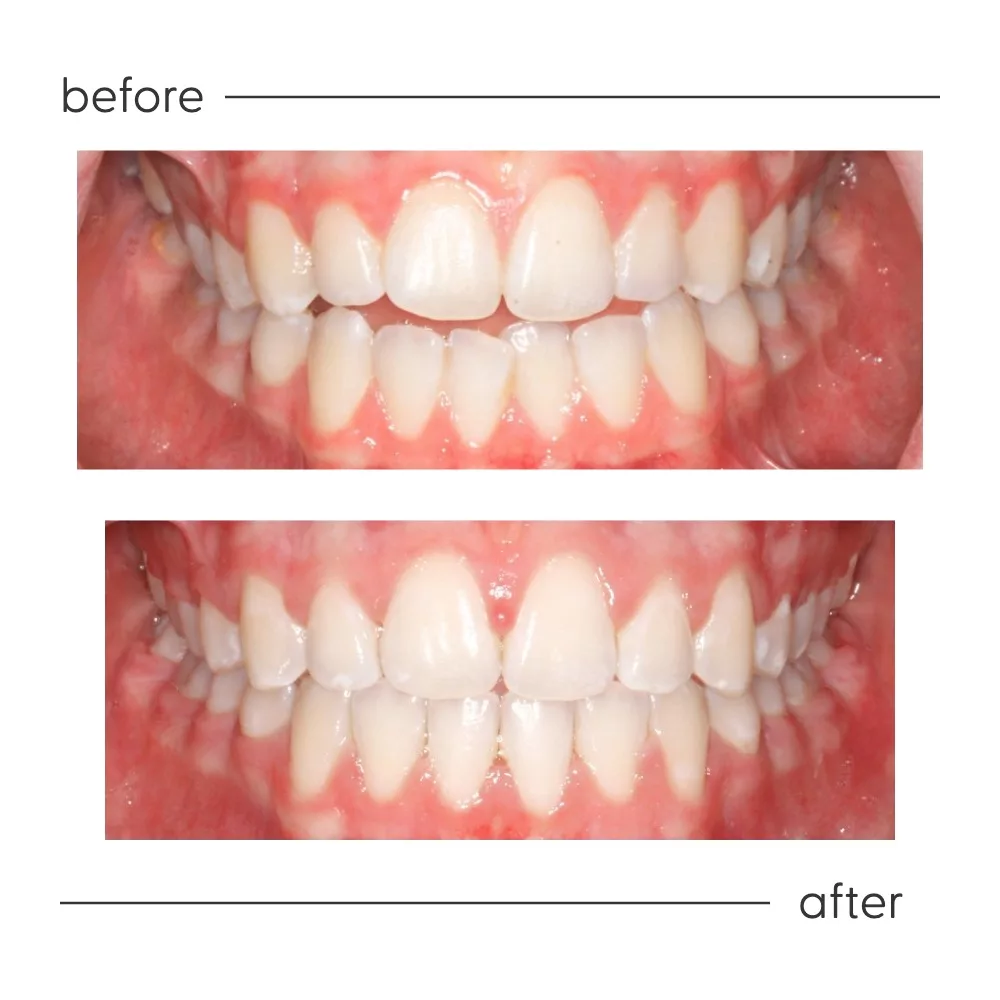
Does my child have an open bite?
An open bite is when the front teeth do not meet even though the back teeth are together, leaving a gap you could slide a tongue through. In children it usually comes from a thumb, dummy or tongue habit, and if the habit stops early enough the bite often closes by itself. Here is how to check at home, what is normal while the adult teeth are still coming through, and when a specialist look is worth it.
Free first step, no referral needed. Choose Newmarket or Albany and switch at any time.
Reviewed by Dr Shaz MacAvoy, Specialist Orthodontist. Doctor of Clinical Dentistry (Orthodontics), registered with the Dental Council of New Zealand.
Three reasons the front teeth do not meet
The same gap can come from a habit, from the tongue, or from the way the jaws are growing. Which one it is decides the treatment, and only a specialist look tells them apart.
A sucking habit that holds the teeth apart
The most common cause. A thumb, finger or dummy sitting between the teeth for hours a day stops the front teeth coming down to meet. Stopped before the adult front teeth have settled, the bite often closes on its own over the following year.
A tongue that pushes forward
Some children push the tongue between the front teeth every time they swallow, or rest it there with the mouth open. That gentle pressure, repeated all day, keeps the gap open even after a sucking habit has stopped. It usually goes with mouth breathing.
Jaws that are growing long
Less common, and the version that matters most. The face grows more downwards than forwards, the back teeth come through further than the front, and the lips struggle to close at rest. This pattern keeps developing until growth finishes, so we watch it closely.
A two minute self check at home
Ask your child to bite their back teeth together naturally and lift their lips. Good light, and look from the front first, then the side.
A gap that is still there once the adult front teeth are fully through, or any gap with a habit or a tongue thrust behind it, is worth a free look. Read when a child should first see an orthodontist.
Six signs an open bite is worth a specialist look
None of these is an emergency. They are the things we would rather see while a habit is easy to stop and growth is still on our side.
The habit is still going at 5 or 6
Sucking that continues once the adult front teeth arrive holds them apart and tips them forward. Stopping it now, with a bit of help, is the single most useful thing a family can do. The bite often closes by itself within a year.
The tongue sits between the teeth
A tongue that pushes forward on swallowing or rests between the teeth keeps the gap open no matter what else is done. We can show a child how to retrain it, and a small appliance can remind the tongue where to sit while the habit changes.
The lips do not close at rest
Lips that stay apart, a mouth that hangs a little open, snoring or mouth breathing all go with an open bite. A narrow upper jaw is often part of the picture, and widening it helps the breathing and the bite together.
Biting and speech are affected
Front teeth that cannot meet make biting into a sandwich or an apple awkward, and a lisp is common. Both improve once the teeth come together.
The back teeth are doing all the work
When only the back teeth touch, they take every bite and wear faster than they should. Closing the front of the bite spreads the load again.
The face looks long and the chin sits back
A long lower face with a small chin points to a growth pattern rather than a habit. That is the version we want to see early, because how the jaws are growing only shows to a specialist, and the plan depends on it.
The right age to act on an open bite
Habits first, teeth second, and for the jaw-based version an honest conversation about growth.
Age 5 to 9: stop the habit, then watch
The first look is around 6 to 8, once the adult front teeth are coming through. If a sucking habit is the cause, we help your child stop it, with a small habit appliance if gentle methods have not worked. Most bites then close on their own, and we check again at no charge.
Age 10 to 14: closing the bite
Once the adult teeth are through, braces or clear aligners with small elastics bring the front teeth together, and tongue retraining stops the gap reopening. If a narrow upper jaw or mouth breathing is part of the picture, an expander goes first.
Age 15 and up: finishing, and honest limits
Habit and tongue open bites close well with braces or aligners at any age. For the small number of jaw-based open bites that keep opening as the face grows, the complete correction is braces combined with jaw surgery as a young adult, and we say so at the start rather than promise what braces alone cannot do.
Open bites are one of the bites most likely to reopen if the tongue or the habit is not sorted, so retainers and the tongue work matter as much as the braces. See thumb sucking, palatal expanders and why teeth can move after braces.
What it looks like when treated
Real young Milk Orthodontics patients, treated by a specialist and shared with their permission.
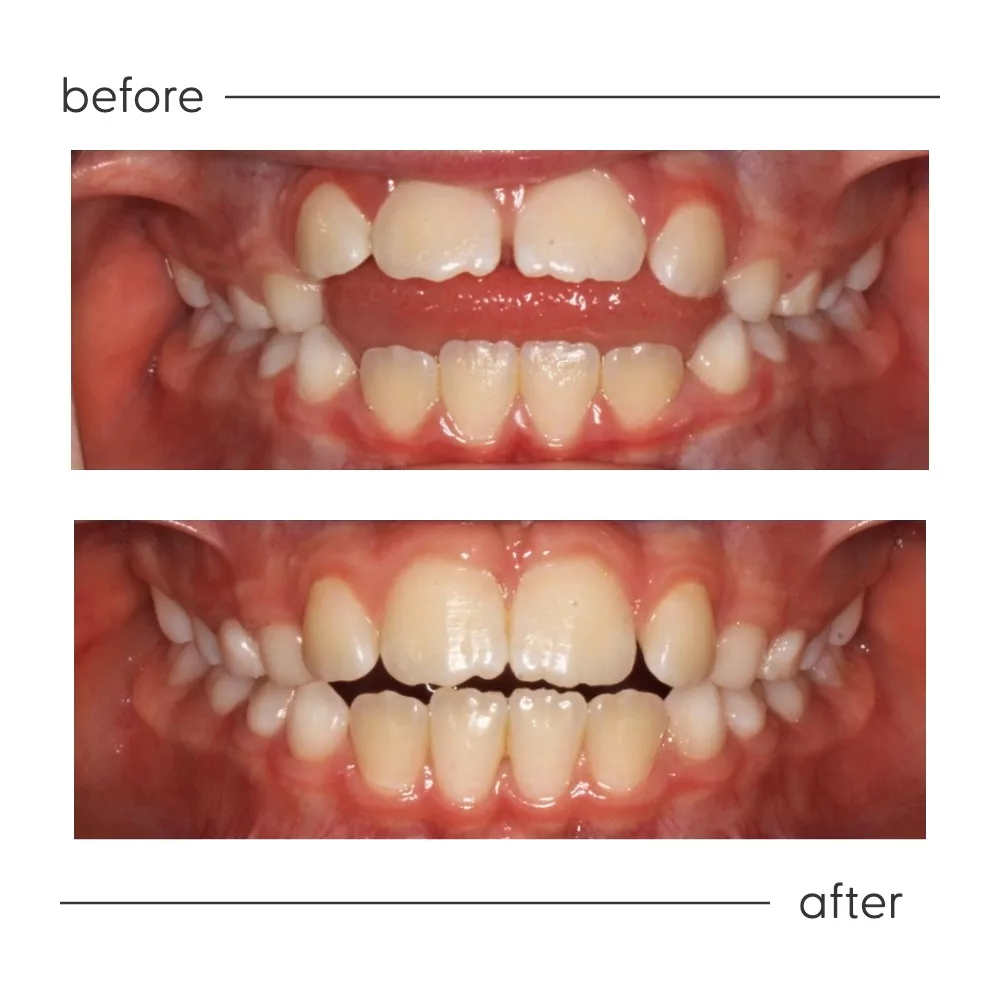
More on how we treat an open bite, all the conditions we treat and more before and after results.
What it costs, and what is free
The first visit is a free Smile Assessment. Help to stop a habit is often all a young child needs. Where an appliance is needed, early treatment starts from $4,500. Comprehensive braces or aligners for children and teens are from $9,900 all-inclusive, most cases around $10,400. Interest-free plans spread the cost over treatment, and there is a family discount for siblings.
Answered honestly
What is an open bite?
When the front teeth do not meet even though the back teeth are together, leaving a gap at the front. Orthodontists call it an anterior open bite. In children it usually comes from a thumb, dummy or tongue habit. Less often it comes from jaws that are growing long rather than forward.
Is it normal for a child's front teeth not to meet?
For a while, yes. Between about 6 and 8 the adult front teeth are still coming down, and a gap while they do is common and usually closes on its own. A gap that is still there once the adult front teeth are fully through, or one with a habit or a tongue thrust behind it, is worth a free look.
Does thumb sucking cause an open bite?
It is the most common cause. A thumb, finger or dummy sitting between the teeth for hours a day stops the front teeth coming down to meet, and tips the top ones forward. If the habit stops before the adult front teeth have settled, the bite often closes by itself, as it did for the child shown above.
Will my child grow out of an open bite?
A habit open bite often closes within a year of the habit stopping, and we simply check again. A tongue thrust open bite stays open until the tongue is retrained. A jaw-based open bite tends to get more open as the face grows, not less, which is why we want to see that pattern early.
What is a tongue thrust?
Pushing the tongue forward between the front teeth on every swallow, or resting it there with the mouth open. It is normal in babies and usually fades by school age. When it stays, the constant gentle pressure keeps the front teeth apart. Children can be taught a new swallow, and a small appliance can help remind the tongue where to sit.
At what age should an open bite be treated?
The first look is around 6 to 8. Habits are stopped as early as possible, because that alone often closes the bite. Braces or aligners to close a gap that remains usually start around 10 to 14, once the adult teeth are through. The first assessment is free, and if it can wait we say so.
How is an open bite treated in a child?
Habit first: gentle strategies to stop sucking, and a small habit appliance if they have not worked. Then the tongue, with simple retraining and sometimes a reminder appliance. If a gap remains once the adult teeth are through, braces or clear aligners with small elastics bring the front teeth together. A narrow upper jaw is widened with an expander first if breathing is part of the picture.
How much does open bite treatment cost for a child in NZ?
Help to stop a habit is often all a young child needs. At Milk, early treatment with an appliance starts from $4,500. Comprehensive braces or aligners for children and teens are from $9,900 all-inclusive, most cases around $10,400. The Smile Assessment is free, and the written plan with an exact quote follows the $390 New Patient Consultation.
Front teeth not meeting? Let us take a look
A free 20 minute Smile Assessment with our Treatment Coordinator at Newmarket or Albany. No referral, no obligation, and if the answer is wait, we will say so.
More self checks: does my child have a crossbite, does my child have an overbite, does my child have buck teeth and does my child have an underbite. Or start with the ten signs your child may need braces.